

The Imperative of Reversibility in Heritage Conservation
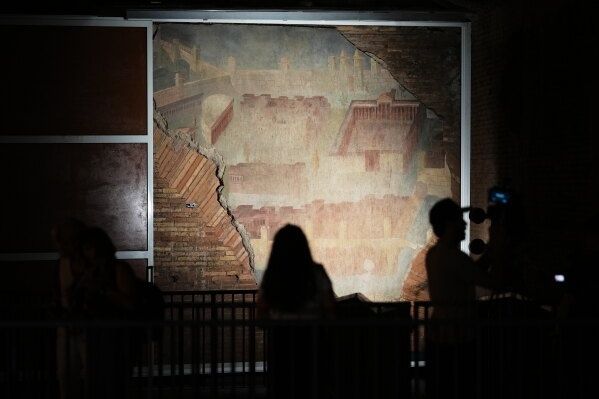
Heritage conservation begins with a difficult obligation: protect what survives without allowing today”s intervention to become tomorrow”s damage. Physical repainting, varnishing, resin consolidation, and aggressive cleaning can improve immediate legibility, but each introduces material change. Once a consolidant has penetrated a porous substrate or a new paint layer has covered an original fragment, removal may be incomplete, risky, or impossible. The same problem applies when the historical appearance is uncertain. A well-intentioned reconstruction can quietly convert a hypothesis into a permanent visual fact.
Non-contact digital polychromy offers a different balance between visibility and restraint. Instead of adding pigment, a calibrated image is projected onto the existing surface, compensating optically for losses while leaving the artefact untouched. The intervention can be switched off, revised, or removed without solvent, abrasion, or mechanical disturbance. This does not make projection automatically safe or historically correct. It makes the method governable, provided the institution controls exposure, documents uncertainty, and treats the digital layer as an interpretive instrument rather than a replacement for the original object.
Understanding Digital Polychromy and Non-Invasive Illumination
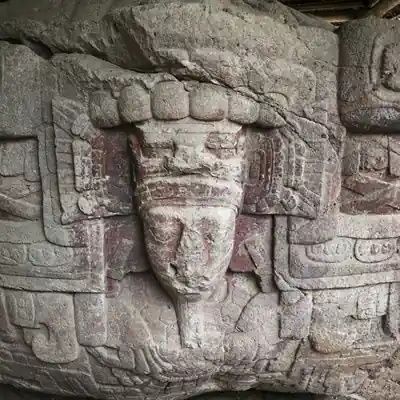
Colour loss is a recurring consequence of age, environment, use, and previous intervention. Monumental reliefs, painted sculpture, architectural surfaces, and murals often retain traces of an original chromatic system even after large areas have faded or eroded. What disappears is not merely isolated colour. Tonal hierarchy, edge definition, figure-ground separation, and relationships between adjacent pigments can become difficult to read. A red garment may survive only as a dull residue, while a surrounding ground has darkened, making the original composition visually incoherent.
Optical compensation addresses that problem by applying light, not foreign material. A projection system maps carefully controlled colour values onto corresponding areas of the surface. Where original paint remains, the projected image can be restrained so that texture and surviving evidence remain visible. Where colour is missing, the projection may supply a provisional reconstruction based on documented traces, comparative evidence, or digitally corrected historical imagery. The key difference is that the visual result and the physical artefact remain separate layers.
The restoration of Mark Rothko”s Harvard Murals illustrates both the promise and the unresolved questions. After differential fading made the five panels difficult to experience as an ensemble, a conservation team working with MIT”s Camera Culture group developed coloured-light projection based on digitally corrected 1964 Ektachrome slides and a rejected sixth panel retained by Rothko”s estate. The approach sought to recover lost colour while preserving the unvarnished surfaces, brushwork, canvas edges, and evidence of the paintings” material history. The project also revealed a central limitation: projected light can restore chromatic relationships, but it may flatten or visually compete with layered paint and texture.
- Record surviving pigment and surface condition before designing any projection.
- Separate documented colour evidence from comparative inference and artistic interpretation.
- Maintain a switchable, versioned digital layer so alternative reconstructions can be evaluated without touching the object.
- Use calibrated equipment and exposure controls rather than treating projection as ordinary exhibition lighting.
Empirical assessments of illumination projects, such as a comparative analysis of projection mapping applications and narrative tendencies at cultural heritage sites, demonstrate how light-based installations frequently risk prioritising theatrical spectacle over interpretive accuracy. Understanding these narrative tendencies underscores why strict analytical controls must precede any public projection, ensuring that conjectural storytelling does not obscure genuine physical traces or discolouration. In practical terms, mapping should begin with what the artefact can substantiate, not with what a designer believes the finished image ought to look like.
Comparing Traditional Physical Intervention with Optical Reconstruction
Physical intervention remains necessary in some circumstances. A fragile flake may require structural stabilization, and a detached layer may need carefully justified consolidation to prevent loss. Projection cannot reattach a fragment, stop active powdering, or correct an unstable support. Its advantage lies elsewhere: it can restore visual coherence without adding a binder, pigment, varnish, or filler to the historical surface. That distinction is especially important where the material response of an object is poorly understood.
Resin consolidation can alter gloss, refractive index, porosity, and colour. Binders may yellow or become brittle, while inpainting can create a visual certainty that exceeds the evidence. Digital reconstruction has its own risks, including inaccurate alignment, excessive saturation, and algorithmic invention. Research into computational mural restoration, such as the DiffuMural framework for damaged Dunhuang murals, demonstrates why large missing regions require structured evaluation of colour, texture, edges, context, and overall coherence rather than a simple appeal to visual attractiveness.
| Evaluation area | Physical intervention | Optical reconstruction |
|---|---|---|
| Surface risk | May involve contact, penetration, abrasion, or added layers | No physical contact when correctly installed |
| Chemical reversibility | Removal can be incomplete and may stress the original | Digital content and light can be withdrawn immediately |
| Diagnostic clarity | New materials may obscure or alter evidence | Original evidence remains accessible for further study |
| Geometric accuracy | Depends on the skill and judgment of the restorer | Can achieve precise alignment, but only with accurate surveying |
| Interpretive control | Revisions may require another physical campaign | Multiple documented versions can be compared |
| Structural support | Can stabilize damaged material where justified | Cannot arrest active deterioration |
The table makes the practical boundary clear. Projection is strongest as a reversible interpretive and perceptual intervention, not as a substitute for every conservation treatment. A responsible programme therefore uses optical reconstruction alongside, rather than instead of, narrowly targeted structural conservation. The institution should be able to explain which problems are being solved by light and which still require physical care.
Assessing Photochemical Exposure and Material Impact
“Non-contact” does not mean “impact-free.” Light can cause photochemical change, particularly in fugitive dyes, degraded binders, exposed grounds, and materials already weakened by previous illumination. Risk assessment must therefore consider illuminance, spectral power distribution, duration, distance, beam concentration, and the condition of the substrate. A low average lux value may still conceal concentrated exposure on a small vulnerable detail, while a bright image projected for a short period may have a different risk profile from dim continuous illumination.
Thermal output also requires attention. Projection engines, power supplies, and poorly ventilated enclosures can raise local temperature or alter airflow near a monument. Ultraviolet and infrared components should be measured rather than assumed away. Ultra-short-throw solid-state laser systems may be attractive because they can provide stable colour, precise geometry, and, in suitable configurations, no ultraviolet emission. That specification is useful, but it is not a complete safety assessment. Visible light itself can drive fading, and the system”s actual spectral output must be tested at the artefact.
Operational discipline is the most practical safeguard. Institutions should establish a duty cycle that links viewing hours to material sensitivity and monitoring results. The projection may operate only during supervised access, at restricted brightness, or in scheduled intervals separated by dark periods. Exposure logs should record illuminance, spectral measurements, operating time, temperature, humidity, and any alarms or deviations. Thresholds should be set conservatively and reviewed when the image, hardware, season, or visitor pattern changes.
- Measure light at the surface, not only at the projector or control console.
- Characterize visible, ultraviolet, and infrared output independently.
- Monitor temperature and humidity near the object and compare readings with a baseline period.
- Use automatic shutdown when illuminance, temperature, alignment, or ventilation falls outside approved limits.
- Schedule dark recovery periods and review cumulative exposure at every conservation assessment.
Navigating Interpretive Bias and Archival Authenticity
The greatest intellectual risk is not technical misalignment but unjustified certainty. A missing blue may be supported by a surviving microscopic trace, a historical photograph, a pigment distribution pattern, or comparison with related objects. It may also be guessed from conventional iconography. Those sources do not carry equal evidentiary weight. A projection that presents all reconstructed areas with the same visual confidence can mislead visitors and future researchers, even when the image is beautifully rendered.
A robust workflow combines multispectral imaging, Raman spectroscopy, microscopy, stratigraphic examination, historical documentation, and comparative analysis. Multispectral imaging can identify patterns invisible under ordinary illumination, while Raman spectroscopy may help characterize inorganic pigments without sampling in selected conditions. Stratigraphy is essential where multiple campaigns or overpaints have created a layered history. The digital model should preserve these distinctions by attaching provenance and confidence values to each region rather than collapsing them into one seamless surface.
Spatial accuracy is equally important. Research on virtual archaeological reconstruction methodology demonstrates the value of combining historical research, field inspection, laser scanning, photogrammetry, georeferencing, and interdisciplinary review. The same principle applies to projected conservation. A visually convincing image can still be wrong if it is registered to an inaccurate geometry or if historical sources are combined without a documented spatial framework.
Every installation should disclose its layers. Visitors and researchers should be able to determine which colours are surviving, which are digitally corrected, which are reconstructed from strong evidence, and which remain hypothetical. The archive should preserve the original capture data, processing steps, calibration files, software versions, projection parameters, and approval history. This transparency does not weaken the experience. It protects the distinction between artefact and interpretation, which is precisely what makes a reversible intervention ethically defensible.
Standard Operating Framework for Light-Based Monument Safeguarding
A successful project is best treated as a conservation campaign with a digital delivery system, not as an event-production exercise. Before equipment is purchased, the institution should establish the object”s condition, material sensitivity, historical evidence, and acceptable level of interpretation. Independent review by conservators, imaging specialists, historians, and, where relevant, descendant or stakeholder communities can expose assumptions that a purely technical team might miss.
- Complete a photometric, environmental, and pigment baseline, including surface condition, existing illumination history, and areas of exceptional vulnerability.
- Capture high-density photogrammetry and structured-light or laser scans to create a geometrically reliable surface model. Confirm registration at sub-millimetre scale where the object and projection distance make that precision meaningful.
- Build the reconstruction from spectral measurements, archival images, stratigraphic evidence, and clearly labeled comparative sources. Assign confidence levels to every reconstructed region.
- Calibrate the projector through a feedback loop using a spectrophotometer, reference targets, and measurements taken on representative surface areas. Recheck calibration after installation and whenever hardware or geometry changes.
- Run a controlled pilot at reduced intensity. Inspect alignment, colour response, thermal behaviour, visitor visibility, and interaction with surviving texture before authorizing full operation.
- Monitor illuminance, temperature, humidity, equipment status, and operating time in real time. Retain exposure records as part of the object”s conservation file.
- Review the installation at defined intervals, comparing new observations with the baseline and suspending projection if unexpected fading, heating, glare, or surface change appears.
This framework also supports responsible maintenance. Projectors drift, lenses accumulate dust, software updates alter colour management, and building conditions change. A map that was accurate at installation can become misregistered after a minor hardware movement. Routine verification is therefore not optional. The digital asset should be version-controlled, independently backed up, and accompanied by enough technical documentation for another institution or future team to reproduce, revise, or retire the intervention.
Establishing Responsible Stewardship for Digital Restoration
Projection mapping can serve the principle of reversibility in a particularly direct way. It allows institutions to recover visual relationships without pretending that lost material has physically returned. Used carefully, it aligns with the conservation ethic associated with the Venice Charter by distinguishing preservation from conjectural reconstruction and by making intervention legible rather than concealed. Its ethical strength comes not from novelty, but from restraint, documentation, and the ability to withdraw the treatment without further altering the object.
The next step is the development of shared standards for luminous exposure, spectral reporting, calibration, uncertainty labeling, and long-term digital preservation. Heritage managers planning a non-contact restoration should begin with a condition and evidence audit, commission independent photometric testing, define an explicit duty cycle, and publish the boundaries of the reconstruction. The central question is not whether projection can make a damaged surface look complete. It is whether the institution can make that visual assistance precise, measurable, reversible, and honest about what remains unknown.